
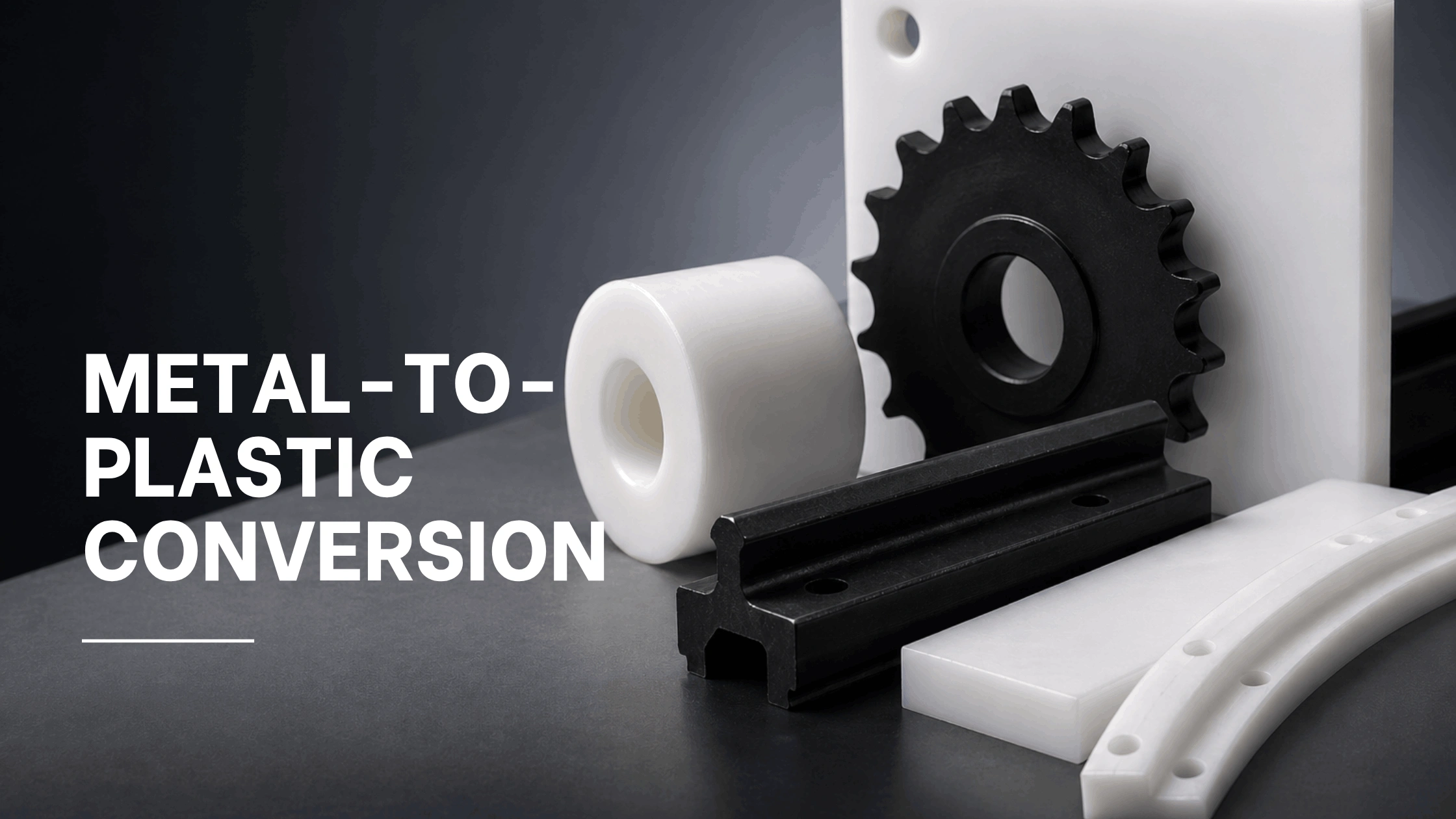
Metal-to-plastic conversion replaces metal components, such as bushings, gears, rollers, and wear pads, with engineered plastics to reduce corrosion, weight, noise, and lubrication needs. Lehigh Valley Plastics evaluates the application load, temperature, and wear conditions to select the right material and design for the replacement part.
Improve Performance, Reduce Maintenance, and Eliminate Common Metal Failure Points
Metal has traditionally been the go-to material for industrial components. But in applications where corrosion, weight, noise, lubrication, or wear are creating problems, metal may not always be the best long-term solution.
Replacing steel, aluminum, bronze, stainless steel, or cast iron with the right engineered plastic can improve performance, reduce maintenance, and increase the service life of both the component and the equipment around it.
A metal-to-plastic conversion is more than simply machining the same part out of plastic. Engineered plastics react differently to load, temperature, moisture, friction, and dimensional changes. The material and the design need to be looked at together.
At Lehigh Valley Plastics, we work with engineers, OEMs, maintenance teams, and purchasing groups to evaluate applications where an engineered plastic may provide a better solution than the existing metal component.
Why Replace Metal with Engineered Plastic?
There are several reasons customers look at converting a metal component to plastic. In most cases, there is an existing problem they are trying to solve.
Reduce Component Weight
Engineered plastics are significantly lighter than most metals. Reducing component weight can make installation easier, reduce the load on surrounding equipment, and improve the performance of moving assemblies.
Weight reduction can be especially beneficial for • robotic and automated equipment • cranes and lifting equipment • rail applications • conveyor systems • packaging machinery • mobile heavy equipment • large rollers, sheaves, and wear components.
For moving components, reducing weight can also decrease the energy required to accelerate, stop, or reposition an assembly.
Eliminate Corrosion
Corrosion is one of the most common reasons to consider a metal-to-plastic conversion.
Metal components exposed to moisture, chemicals, washdown, saltwater, or outdoor environments can rust, oxidize, or chemically degrade over time.
Many engineered plastics are naturally corrosion resistant and do not require painting, plating, galvanizing, or other surface treatments. This makes them a strong option for • food processing • marine and offshore equipment • chemical processing • washdown environments • outdoor equipment • material handling.
Chemical compatibility still needs to be reviewed based on the actual chemical, concentration, temperature, exposure time, and load on the component.
Reduce Lubrication and Maintenance
Many wear-grade engineered plastics offer low-friction or self-lubricating properties. Depending on the application, they may be able to operate with little or no external grease or oil.
Benefits can include • less scheduled maintenance • cleaner equipment • reduced grease and oil consumption • less dirt and debris around wear points • lower risk of product contamination • easier maintenance in difficult-to-access areas • reduced environmental concerns from lost lubricant.
This can be especially valuable on large pieces of equipment with hundreds of wear points or in areas that are elevated, enclosed, submerged, or otherwise difficult to service.
Reduce Noise and Vibration
Metal-on-metal contact can create significant noise, vibration, chatter, and impact. Engineered plastics can help absorb vibration and provide a softer contact surface.
Plastic gears, rollers, bushings, wear pads, guides, and chain components can often operate much quieter than their metal counterparts.
This can be especially beneficial on • conveyor systems • packaging equipment • processing lines • rail equipment • material handling systems • automated machinery.
Protect More Expensive Components
Sometimes the metal wear component is not the most expensive part of the system. The damage it causes to the surrounding equipment is.
A metal bushing can damage a shaft. A metal sheave can wear wire rope. Metal wear pads or guides can damage painted, plated, or machined surfaces.
Using a properly selected engineered plastic allows the plastic component to become the designed wear item. The plastic part can then be replaced during scheduled maintenance before damage reaches the larger and more expensive assembly.
Improve Equipment Uptime
Corrosion, seized components, inadequate lubrication, excessive friction, and damage to mating surfaces can all lead to unexpected downtime.
A properly selected engineered plastic may provide more predictable wear and make it easier to plan replacement during normal maintenance intervals.
A metal-to-plastic conversion should not be evaluated on part price alone. The overall cost should also consider • downtime • maintenance labor • lubrication • installation time • replacement frequency • damage to mating components • equipment availability.
In many applications, the real value of the conversion comes from reducing these long-term operating costs.
What Metal Components Can Be Converted to Plastic?
Some of the best metal-to-plastic conversion opportunities are components that slide, rotate, guide, support, protect, or control movement.
Common candidates include • bushings and bearings • wear pads and slide plates • sheaves and pulleys • rollers and wheels • gears and sprockets • chain and belt guides • wear strips and conveyor rails • thrust washers • spacers and isolators • scraper blades • valve seats and sealing components • manifolds and fluid-handling components • grippers and product-handling components • electrical and thermal insulators • equipment guards • timing screws • star wheels • machine change parts • subsea plugs, guides, and protective components.
Not every metal part should be converted to plastic. The best opportunities are normally applications where the current component is experiencing a specific problem such as corrosion, excessive weight, frequent lubrication, noise, premature wear, or damage to surrounding equipment.
Metal and Plastic Behave Differently
One of the biggest mistakes in a metal-to-plastic conversion is assuming the existing metal print can simply be machined from plastic with no changes.
Engineered plastics have different stiffness, thermal expansion, creep, moisture absorption, and tolerance capabilities than metals.
In some applications, the same geometry will work. In others, a few design changes can make a major difference in how the plastic component performs.
Load and Stress
The type of load on the component needs to be understood, including • compression • tension • bending • impact • shear • or a combination of loads.
Engineered plastics can perform extremely well in compression and wear applications, but thin sections, sharp corners, unsupported loads, and high stress concentrations may require additional consideration.
Long-Term Loading and Creep
Plastics can gradually deform when held under a constant load, particularly as temperature increases.
For continuously loaded components, material creep data, geometry, load duration, and safety factors should all be considered.
Temperature
Temperature can have a major impact on the mechanical properties of an engineered plastic.
It is important to understand the actual operating temperature at the component, not just the ambient temperature around the machine. Additional heat can come from • friction • steam • washdown • nearby heaters • chemicals • repeated machine cycles.
Thermal Expansion
Engineered plastics generally expand and contract more than metals as temperature changes.
This can affect • running clearances • press fits • hole locations • bearing performance • assembly tolerances.
The design may need to allow additional clearance for expected temperature changes.
Moisture Absorption
Certain engineered plastics absorb more moisture than others.
In wet, humid, submerged, or washdown applications, moisture absorption can affect both dimensions and mechanical properties and should be considered during material selection.
Friction and Wear
Wear performance depends on more than just the plastic material.
Important factors include • load • speed • type of movement • shaft material • shaft finish • lubrication • contamination • temperature.
A material that performs well in a slow oscillating application may not be the right material for continuous high-speed rotation. Understanding the actual application is critical.
Chemical Exposure
Chemical resistance needs to be reviewed against the actual operating conditions.
Important factors include • specific chemical • chemical concentration • temperature • mechanical stress • length of exposure.
Simply calling a material “chemically resistant” does not mean it will work with every chemical or under every operating condition.
Tolerances and Machining Stability
Engineered plastics can be machined to very precise dimensions, but tighter is not always better.
Unnecessarily tight tolerances can increase machining and inspection costs without improving how the component performs.
Tolerance requirements should be based on the function of the part, assembly method, temperature range, material condition, and inspection requirements.
How LVP Approaches a Metal-to-Plastic Conversion
At LVP, we look at the entire application before recommending a material or design change.
1. Understand the Existing Problem
The first question is simple: Why are we looking at replacing the metal component?
Common reasons include • corrosion • frequent lubrication • excessive weight • noise • premature wear • seizure or galling • damage to mating components • product contamination concerns • difficult installation • high replacement costs • difficult maintenance • obsolete or hard-to-source components.
Understanding the current failure point helps make sure the replacement component is solving the actual problem.
2. Review the Application
Next, we look at the operating conditions that will directly impact material performance.
This can include • static and dynamic loads • operating and peak temperatures • speed and movement • chemical exposure • moisture and washdown • outdoor or UV exposure • impact and vibration • shaft and mating materials • tolerance requirements • regulatory requirements • expected service life.
The more information we have about the application, the better we can evaluate the material and design.
3. Evaluate Material Options
Once we understand the application, we can compare engineered plastic materials based on the properties that actually matter.
The goal is not always to select the material with the highest published mechanical properties. The goal is to find the most practical material that meets the performance requirements while also considering machinability, compliance, availability, and overall cost.
Depending on the application, potential materials may include • UHMW-PE • HDPE • Acetal • Nylon • PET • PBT • PTFE • Modified PTFE • PEEK • PPS • PAI • PVDF • other high-performance engineered plastics.
4. Review the Part Design
LVP can review an existing print, sample, or component for plastic-specific design considerations.
Potential changes may include • adding material in highly loaded areas • increasing corner radii • eliminating sharp internal transitions • adjusting press fits • increasing running clearances • supporting long or unsupported sections • eliminating unnecessary tight tolerances • allowing for thermal expansion • allowing for moisture-related dimensional changes • modifying fastener or attachment details.
Sometimes the existing metal design works perfectly well in plastic. Other times, a relatively small design change can significantly improve the life and performance of the component.
5. Prototype and Validate
For critical or unfamiliar applications, prototyping or a controlled production trial may be the best approach.
Testing can help evaluate • fit and assembly • load performance • wear • temperature • noise • dimensional stability • chemical resistance • inspection results • installation • maintenance requirements.
Whenever possible, actual application testing should be part of validating the final conversion.
6. Move Into Production
Once the material and design have been validated, LVP can support the application through repeatable production.
Our team works with customers on everything from one-time replacement parts and prototypes to ongoing production programs requiring documented machining, inspection, and quality processes.
Industries Where Metal-to-Plastic Conversion Makes Sense
Heavy Equipment
Heavy equipment applications often involve high loads, outdoor exposure, dirt, impact, and difficult maintenance access.
Common applications include • wear pads • bushings • bearings • sheaves • pulleys • rollers • guides • thrust washers • sliding components.
The right engineered plastic can help reduce lubrication, protect expensive mating components, decrease weight, and improve service life.
Rail
Rail equipment is exposed to vibration, weather, impact, dirt, and continuous wear.
Common applications include • wear pads • bushings • rollers • guides • insulators • bearing components • sliding wear surfaces.
Engineered plastics can help reduce noise, corrosion, lubrication, and wear on surrounding components.
Conveyors and Material Handling
Conveyor systems can contain hundreds or even thousands of moving and wear components.
Applications include • wear strips • chain guides • belt guides • rollers • bushings • bearings • sprockets • product guides • slide plates.
Reducing friction and lubrication requirements across these wear points can have a significant impact on maintenance and equipment uptime.
Food Processing
Food processing equipment requires materials that can handle washdown, moisture, chemicals, and contamination concerns.
Common applications include • bearings • bushings • wear strips • rollers • guides • scrapers • star wheels • timing screws • product-contact components.
Engineered plastics can provide corrosion resistance while eliminating the need for paint, plating, or external lubrication in certain applications. Material compliance and cleaning requirements should always be considered during material selection.
Marine and Offshore
Saltwater and offshore environments can be extremely difficult on metal components.
Applications can include • bushings • bearings • sheaves • wear pads • guides • rollers • subsea plugs • protective components • fluid-handling components.
Engineered plastics provide an opportunity to eliminate corrosion while reducing weight and lubrication requirements. Material selection should consider water absorption, pressure, load, temperature, chemical exposure, and expected service life.
Packaging Machinery
Packaging machinery operates at high cycle rates and often contains a large number of moving components.
Common applications include • timing screws • star wheels • guides • rollers • bushings • bearings • wear strips • grippers • change parts • product-handling components.
Reducing weight, friction, noise, and lubrication can improve machine performance and simplify maintenance.
Is Your Metal Component a Candidate for Conversion?
If a current metal component is rusting, wearing out, requiring constant lubrication, creating excessive noise, damaging another part of the machine, or simply adding unnecessary weight, it may be worth evaluating an engineered plastic alternative.
The key is selecting the right material and designing the component around the actual operating conditions.
Lehigh Valley Plastics can work with your engineering, maintenance, and purchasing teams to review the application, evaluate material options, and determine whether a metal-to-plastic conversion makes sense.
Send us a print, sample, or application information and our team can help determine the next step.
Frequently Asked Questions
What is metal-to-plastic conversion?
Metal-to-plastic conversion replaces metal components — such as bushings, gears, rollers, and wear pads — with engineered plastics to reduce corrosion, weight, noise, and lubrication needs.
Which metal parts can be converted to plastic?
Common candidates include bushings, bearings, wear pads, sheaves, pulleys, rollers, gears, sprockets, thrust washers, scraper blades, valve seats, and other components that slide, rotate, guide, or support movement.
What are the main benefits of converting metal parts to plastic?
Benefits include corrosion resistance, reduced weight, less lubrication and maintenance, lower noise and vibration, protection for more expensive mating components, and improved equipment uptime.
Can any metal part be replaced with plastic?
No. The best candidates are parts already experiencing a specific problem, such as corrosion, excessive weight, frequent lubrication, noise, or premature wear. Metal and plastic behave differently under load, temperature, and moisture, so each application needs individual evaluation.
What engineered plastics are used in metal-to-plastic conversions?
Depending on the application, materials may include UHMW-PE, HDPE, Acetal, Nylon, PET, PBT, PTFE, Modified PTFE, PEEK, PPS, PAI, and PVDF.
How does Lehigh Valley Plastics approach a metal-to-plastic conversion?
LVP reviews the existing problem, evaluates the application’s operating conditions, compares material options, reviews the part design for plastic-specific changes, and validates the solution through prototyping before moving into production.