
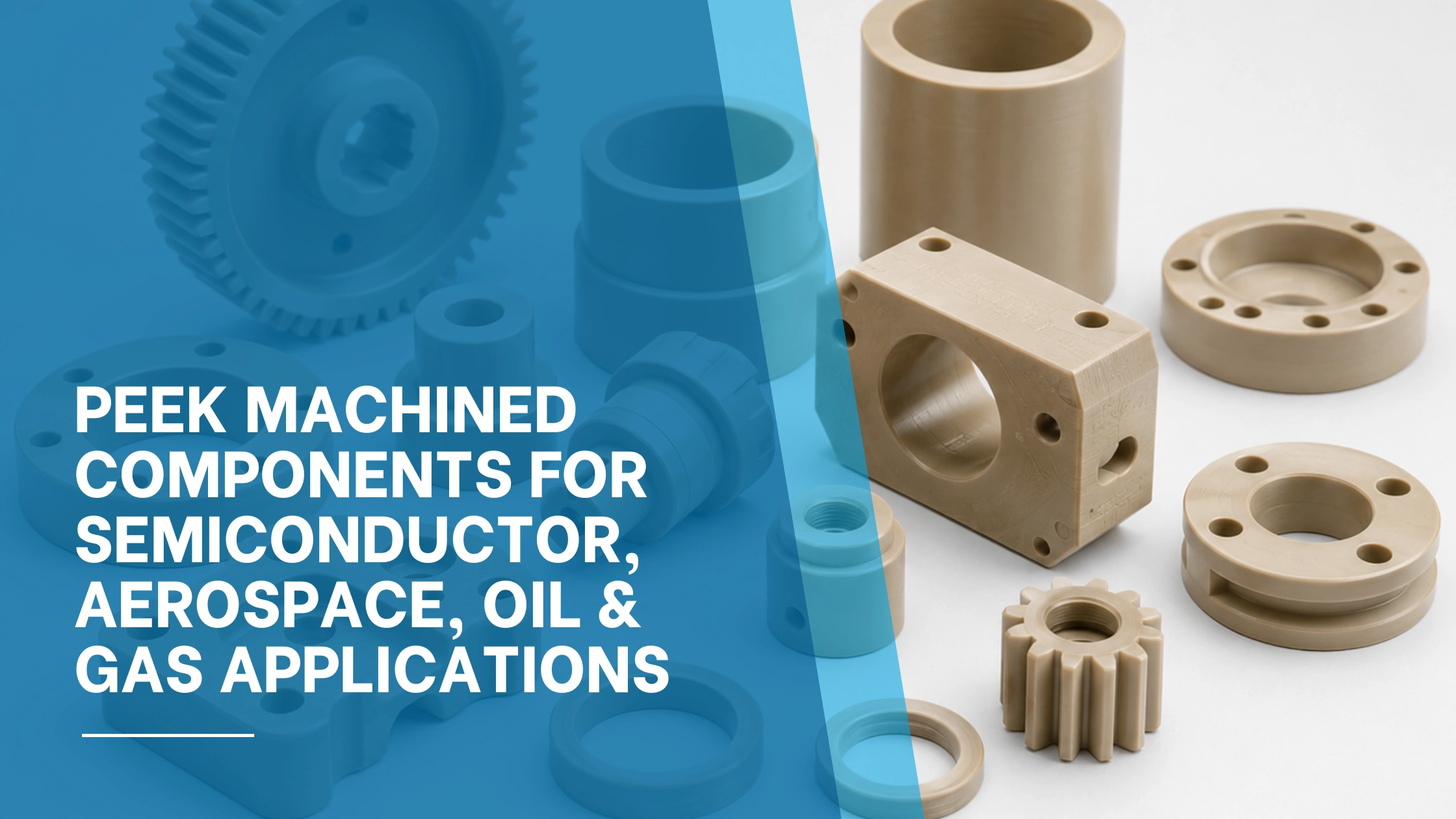
Topic: PEEK Machined Components
Material: PEEK (Polyetheretherketone) — Ketron™, TECAPEEK®, SustaPEEK® Grades
Industries Covered: Semiconductor, Aerospace & Defense, Oil & Gas, Sealing Systems, Electrical / Insulation
Common Applications: Seals, Bushings, Bearings, Insulators, Wafer Handling, Valve Components
When an application requires a machined plastic component that can handle high temperature, chemical exposure, wear, load, dimensional stability, and electrical performance, PEEK is one of the first high-performance materials engineers consider.
PEEK, or polyetheretherketone, is a premium engineered thermoplastic used in demanding applications across semiconductor, aerospace and defense, oil and gas, sealing systems, and electrical / insulation components. It is often selected when standard materials such as nylon, acetal, UHMW, or PTFE cannot provide the required combination of strength, temperature resistance, chemical resistance, and long-term reliability.
At Lehigh Valley Plastics, we machine custom PEEK components to customer prints for OEMs, equipment builders, and industrial customers that need precision plastic parts built for demanding service environments.
Why Engineers Choose PEEK
PEEK is often specified when the application needs a high-performance plastic that can hold up under difficult operating conditions. It offers a strong balance of mechanical strength, thermal resistance, chemical resistance, wear performance, and machinability.
Common reasons engineers specify PEEK include:
- High temperature resistance
- Excellent chemical resistance
- Strong mechanical properties
- Good dimensional stability
- Low moisture absorption
- Good wear and sliding performance
- Hydrolysis and steam resistance
- Electrical insulation properties
- Ability to replace metal in select applications
- Compatibility with demanding industrial environments
PEEK is not always the lowest-cost material option, but it can be the right choice when the cost of failure, downtime, replacement, or field issues is higher than the material cost itself.
PEEK Machining for Semiconductor Applications
Semiconductor equipment requires plastic components that can support precision, dimensional stability, chemical compatibility, cleanliness-focused environments, and tight tolerances. PEEK is commonly reviewed for semiconductor applications because it offers a strong combination of thermal resistance, chemical resistance, mechanical strength, and machinability.
Potential semiconductor PEEK applications include:
- Wafer handling components
- Test sockets
- Precision fixtures
- Insulators
- Bushings
- Wear components
- Valve and fluid handling components
- Chemical processing components
- High-temperature equipment parts
- Electrical isolation components
For semiconductor equipment builders, PEEK can be a strong option when the part needs to maintain dimensional accuracy while exposed to heat, chemical environments, repeated motion, or tight tolerance requirements.
PEEK Machining for Aerospace & Defense
Aerospace and defense applications often require materials that support weight reduction, thermal performance, mechanical strength, wear resistance, and reliability. PEEK is commonly used where metal replacement, insulation, or high-performance plastic components are needed in demanding systems.
Potential aerospace and defense PEEK applications include:
- Lightweight metal replacement components
- Electrical insulators
- Cable and connector components
- Bearings
- Bushings
- Thrust washers
- Seal rings
- Wear components
- Structural plastic parts
- High-temperature equipment components
For aerospace and defense customers, PEEK is often evaluated because it provides high performance without the weight or corrosion concerns of certain metals. It can also be machined into complex components while maintaining strong performance in demanding environments.
PEEK Machining for Oil & Gas Applications
Oil and gas applications often involve pressure, temperature, chemical exposure, wear, and harsh operating environments. PEEK is a strong candidate for components that need to resist hydrocarbons, chemicals, steam, and elevated temperatures while maintaining mechanical strength.
Potential oil and gas PEEK applications include:
- Seals
- Backup rings
- Valve seats
- Wear rings
- Bearings
- Bushings
- Downhole components
- Pump components
- Compressor components
- Insulating components
- Fluid handling components
For oil and gas customers, PEEK may be selected when standard plastics cannot survive the combination of temperature, chemical exposure, and mechanical load.
PEEK Machined Seals and Wear Components
PEEK is commonly used in sealing and wear applications where the part needs to maintain performance under friction, load, temperature, or chemical exposure. Depending on the application, PEEK may be used as an alternative to metal, PTFE, nylon, or other engineered plastics.
Potential PEEK seal and wear applications include:
- Seal rings
- Backup rings
- Valve seats
- Wear rings
- Thrust washers
- Bearing components
- Compressor components
- Pump components
- Dynamic wear components
- High-load sliding components
PEEK is often reviewed for seal applications because it offers strength, chemical resistance, and dimensional stability. In applications where PTFE is too soft or standard plastics creep under load, PEEK may provide improved mechanical performance.
PEEK Electrical and Insulation Components
PEEK is also used in applications that require electrical insulation combined with mechanical strength and temperature resistance. This makes it useful for aerospace, defense, semiconductor, electronics, energy, and industrial equipment applications.
Potential PEEK electrical and insulation applications include:
- Electrical insulators
- Connector components
- Test sockets
- Isolation components
- Spacers
- Housings
- High-temperature electrical components
- Semiconductor support components
- Aerospace electrical components
- Energy system insulation components
PEEK vs. Other Engineered Plastics
PEEK is often compared to materials such as Torlon, Ultem, PPS, PTFE, acetal, and nylon. The right material depends on the operating conditions.
| Material | When It May Be Considered |
|---|---|
| PEEK | Balance of chemical resistance, temperature resistance, mechanical strength, wear performance, and machinability |
| Torlon / PAI | Even higher load-bearing performance, creep resistance, or wear resistance under severe conditions |
| Ultem / PEI | Electrical insulation, dimensional stability, flame resistance, and lower-cost high-performance applications |
| PTFE | Very low friction and broad chemical resistance, but less strength or creep resistance than PEEK |
| Nylon, Acetal, UHMW | More economical options when high-temperature or chemical resistance of PEEK is not required |
PEEK is often selected for its balance of chemical resistance, temperature resistance, mechanical strength, wear performance, and machinability.
Torlon / PAI may be considered when the application requires even higher load-bearing performance, creep resistance, or wear resistance under severe conditions.
Ultem / PEI may be a good fit for electrical insulation, dimensional stability, flame resistance, and lower-cost high-performance applications.
PTFE may be selected for very low friction and broad chemical resistance, but it may not provide the same strength or creep resistance as PEEK.
Nylon, acetal, and UHMW may be more economical options when the application does not require the high-temperature or chemical resistance of PEEK.
At LVP, we can help review the application, print, tolerance requirements, operating environment, and material callout to determine whether PEEK is the right material or whether another engineered plastic may provide better value.
Work With LVP on Custom PEEK Machined Components
Lehigh Valley Plastics machines custom PEEK components for demanding applications across semiconductor, aerospace and defense, oil and gas, sealing systems, and electrical / insulation markets.
PEEK may be the right fit if your part requires:
- High temperature resistance
- Chemical resistance
- Dimensional stability
- Electrical insulation
- Wear resistance
- Low moisture absorption
- Strength under load
- Metal replacement
- Tight tolerance machining
- Performance in harsh operating environments
Send us your print, material requirement, quantity, and application details, and our team can help review whether PEEK is the right material for your component.
Need a PEEK component machined to print? Send us your print for review.
Frequently Asked Questions
What industries use PEEK machined components?
PEEK machined components are used in semiconductor, aerospace, defense, oil and gas, energy, electronics, medical manufacturing, and industrial equipment applications.
Why is PEEK used for semiconductor components?
PEEK is often used in semiconductor equipment because it offers dimensional stability, chemical resistance, temperature resistance, machinability, and strong mechanical performance.
Is PEEK good for aerospace and defense applications?
Yes. PEEK is commonly evaluated for aerospace and defense components where lightweight material, strength, wear resistance, insulation, and temperature performance are important.
Can PEEK be used for oil and gas seals?
Yes. PEEK is commonly reviewed for oil and gas seals, backup rings, valve seats, bearings, and wear components because of its chemical resistance, temperature performance, and mechanical strength.
Is PEEK an electrical insulator?
Yes. Natural PEEK is commonly used as an electrical insulator. Modified PEEK grades may also be available for ESD or conductive applications, depending on the requirements.
Can LVP machine PEEK to print?
Yes. Lehigh Valley Plastics machines custom PEEK components to customer prints and can support material review based on application, tolerance, quantity, and operating conditions.